2024 Energy Storage Summit USA EPRI Resources
Deploying Storage in an Urban Space
Media coverage of hazardous incidents involving lithium ion batteries in electric vehicles, renewable energy storage, and consumer electronics has caused growing public concern of the safety of battery energy storage systems (BESS) installed in populated areas, especially in cities. The occurrence and reporting of these events underscores the need for continuous safety advances through technical due diligence, evolving codes, and coordinated education to contextually understand, mitigate, and communicate BESS hazards and consequences.
Founded in Palo Alto in 1972, EPRI is an independent non-profit energy research, development, and deployment organization with a foundational mission to benefit society. EPRI delivers independent, objective thought leadership and industry expertise to help the energy sector identify issues, technology gaps, and broader needs that can be addressed through effective, collaborative research and development programs. EPRI is an industry leader in energy storage safety and has developed many tools and resources to move the industry towards a safe, reliable, affordable, and clean energy storage future.
This page highlights EPRI's ongoing energy storage safety research program and provides links resources that support and inform decisions around safety of energy storage systems deployed in urban spaces.
EPRI's Energy Storage Safety Research
Fire Prevention and Mitigation for Battery Energy Storage Systems (BESS)
| With a foundational mission to benefit society, EPRI delivers independent, objective thought leadership and industry expertise to the energy sector. EPRI’s portfolio in energy storage includes a collaborative, multi-phase project to understand and close gaps in energy storage safety and subsequent impacts. Our work brings together industry experts to generate new knowledge, identify best practices, and develop a safety toolkit. The research is made publicly available to advance the industry.
EPRI's Battery Energy Storage Fire Prevention and Mitigation project is in Phase 3. Initiated in 2021, Phase 1 of this project consolidated the experience of 15 utility members, 15 non-utility experts, and 10 energy storage site evaluations to identify gaps in safe design and operations of today’s ESS. Phase 2 created a lifecycle safety toolkit, including a retrofit guide, a codes and standards review, emergency response plan guidelines, and more. Moving forward, EPRI will use prior learnings and a new safety roadmap activity to prioritize and further extend the toolkit resources. Industry insights will be incorporated to guide utility owners, operators, and off-takers in their design, procurement, planning, and incident response. |

|

|
Funding participants include 15 major utilities, project developers and insurance companies across the United States and world. The advisory team consists of diverse stakeholders such as National Labs, Fire Departments, fire safety experts, insurance agencies, and academic institutions.
To explore opportunities for collaboration and provide input in Phase 3 of the project, contact Storage-Safety@epri.com. |
BESS Failure Event Database
The database is a public resource documenting battery energy storage failures around the world. It catalogs over 100 incidents in utility and commercial/industrial installations, electric transportation, recycling, manufacturing, and warehousing.
Dependent on the availability of failure event information, database entries include system details, location, a description of the failure event, and links to referenced sources. Reviewing failures of urban installations may provide insights for improved safety and reliability.
To be notified of new entries, contact Storage-Safety@epri.com.

Carnegie Road ESS Failure Response, Recovery, and Rebuild Lessons Learned
| In the early morning hours of September 15, 2020, an explosion occurred at the Carnegie Road energy storage site in the UK, followed by a fire that consumed one of three energy storage enclosures. This report conveys the lessons learned from the failure event, including aspects of emergency response, root cause investigation, and the redesign and rebuild process. The document conveys the general information about the failure event and the subsequent process to educate the industry and facilitate the development of best practices. The report highlights the need for clear communication around design features and failure event details, including the development of a post-incident plan. | 
|
Select Safety Resources
| Deliverable Title | Product ID (with link) | Year Published |
|---|---|---|
| The Evolution of Battery Energy Storage Safety Codes and Standards | 3002028521 | 2023 |
| Technology Innovation Spotlight: Lithium Ion Battery Fires in the News | 3002028411 | 2023 |
| Safety Implications of Lithium Ion Chemistries | 3002028522 | 2023 |
| Carnegie Road ESS Failure Response, Recovery, and Rebuild Lessons Learned | 3002026396 | 2023 |
| Air Modeling Simulations of Battery Energy Storage System Fires | 3002021777 | 2022 |
| Difference Between Thermal Runaway and Fire Ignition of a Lithium Ion Battery | 3002025283 | 2022 |
| Battery Storage Fire Safety Roadmap | 3002022540 | 2021 |
| Lessons Learned: Lithium Ion Battery Storage Fire Prevention and Mitigation—2021 | 3002021208 | 2021 |
| Approaches for Evaluating Potential Human Health Consequences of Utility-Scale Lithium-ion Battery Failures | 3002021634 | 2021 |
| Battery Energy Storage Systems Explosion Hazards | 3002022706 | 2021 |
| Proactive First Responder Engagement for Battery Energy Storage System Owners and Operators | 3002021774 | 2021 |
EPRI's Community Aspects of Energy Storage Research
Understanding the impacts of energy storage deployment on communities is critical for mitigating community- or public-driven memorandums and project cancellations. EPRI is an industry leader in how to consider and incorporate equity and environmental justice in energy projects. Regarding BESS, specifically, EPRI is developing guidance on community-based considerations that should be included in all phases of the project life cycle.
Community-Based Siting and Permitting for Grid-Scale Lithium Ion Battery Storage
Community Benefit Planning for Energy Storage Projects
Environmental Aspects of Utility-Scale Energy Storage Systems
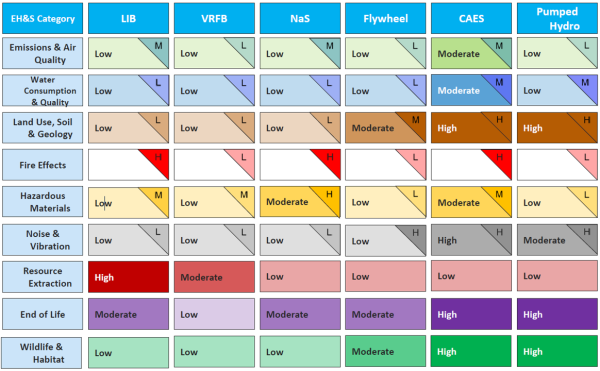

The Environmental, Health, and Safety (EH&S) impacts of energy storage technologies need to be included in project planning. Understanding EH&S impacts during normal operation and abnormal events (e.g., failure scenarios) operation can help to inform siting location and system layout, determine what protective systems or equipment are needed on site, develop an effective emergency response plan, and more. EPRI has developed a framework for comparing the EH&S impacts associated with commercially-viable ESS technologies and continues to update the framework and analysis of various technologies as their commercial viability changes.
About EPRI
Together...Shaping the Future of Energy
With a foundational mission to benefit society, EPRI delivers independent, objective thought leadership and industry expertise to help the energy sector identify issues, technology gaps, and broader needs that can be addressed through effective, collaborative research and development programs.
Who We Are
Founded in Palo Alto, Calif., in 1972, EPRI is an independent non-profit energy research, development, and deployment organization, with three specialized labs. EPRI also maintains an employee presence in more than a dozen countries in Europe/Middle East/Africa, as well as Asia, and the Americas through its subsidiary EPRI International Inc. and its Ireland-based research arm, EPRI Europe DAC. EPRI's trusted experts collaborate with more than 450 companies in 45 countries, driving innovation to ensure the public has clean, safe, reliable, affordable, and equitable access to electricity across the globe.
Who We Work With
Rooted in science and rigor, EPRI collaborates with scientists, engineers, government, and experts from academia and industry to shape and drive technology advancement by pushing the frontier of innovation from concept, pilot, operation to end-of-life.
Our mission is accomplished by an extensive researcher network and a comprehensive advisory structure. Our portfolio of research programs is defined and guided by advisors from both industry and public stakeholders. More than 1,400 leaders and technical experts from the electricity sector, academia, and government help EPRI develop and conduct its research, deliver results, and provide for technology transfer and the application of research findings.
Our Membership
The institute's work is funded by hundreds of organizations around the world, including the energy sector, academia, and government. Organizations who engage in EPRI research, development, and demonstration programs have unique opportunities to:
- Identify and solve critical and emerging industry issues.
- Stay at the forefront of technology innovation.
- Gain access to a comprehensive, timely RD&D portfolio.
- Collaborate and network with industry peers through advisory councils and committees.
- Implement technology through the support of our researchers and technical advisors.
- Reduce future investment risks.
- Inform policies with objective, science-based findings and facts.
Through their advisory roles in EPRI, its research sectors and programs, EPRI members help inform the development of EPRI's annual research portfolio, identify critical and emerging electricity industry issues, and support the application and technology transfer of EPRI's research and development.
EPRI is also the host of the World Energy Council's U.S. Member Committee. The committee brings together individuals, businesses, government, and collaborative organizations and institutions to accelerate the energy transformation and reliably meet critical net-zero climate goals. These goals will be achieved through unique collaborative events with the Council's global network to exchange value-oriented dialogue between energy and non-energy stakeholders, share best practices, and identify new collaborative opportunities.