Energy Storage Safety Products Database - Submission Form

From EPRI Storage Wiki
Jump to navigation Jump to search


The following form is used to submit new entires to the EPRI Energy Storage Safety Product Database. This resource is an internal database provided to funding participants in EPRI energy storage safety research. This research supports the safe deployment of ESS projects. For additional information, see the Battery Storage Fire Safety Roadmap that is linked at the bottom of this page. For multiple product entries, use additional submissions.

For any questions about this form or other EPRI energy storage safety research, please contact our Storage Safety email.

All entries will be reviewed before being considered for inclusion in the database and may be edited for clarity or content.


Energy Storage Safety Product Submission Form
Comments: Please provide a description of the product (500 characters max)
0/500 characters
Safety Technology Category: Help us to understand to what technology category this product belongs (Select all that apply)
  • Sensors & Detection
  • Analysis
  • Thermal Barrier
  • Failure Prevention
  • Fire Suppression
  • Explosion Prevention
  • Explosion Mitigation
  • Environmental
  • Other (if multiple, separate with semicolons)
Integration Level: At what level in the energy storage system is this product integrated? (Select all that apply)
  • Cell
  • Module
  • Unit
  • System
  • Site
  • Other (if multiple, separate with semicolons)
EPRI Energy Storage Safety Roadmap Tags: Tag this product with the relevant Safety Roadmap Tags (Select all that apply)
  • ST1 Addressing the common explosion hazard
  • RP1 Response plan guidelines for existing and future BESS
  • RP2 Response plan standardization
  • RP3 Hazard state identification and communication
  • RP4 Contamination management
  • DT1 Improving availability and application of 9540A testing
  • DT2 Inclusion of gas prediction and deflagration protection tools in BESS design processes
  • DT3 Expansion of 9540A testing to address statistical variation and multiple cell failures
  • DT4 Guidelines for selection and design of suppression systems
  • DT5 Standardized electrical controls reporting
  • DT6 Failure modes and effects analysis (FMEA) guidance
  • DT7 Integrated system design tools
  • DT8 Adequacy and inclusion of thermal runaway propagation prediction tools in BESS design processes
  • TD1 Robust electrical controls
  • TD2 Detection of state of thermal reaction
  • TD3 Detection of future thermal runaway events
  • TD4 Detection of deflagration and toxicity risks
  • TD5 Limitation of propagation using thermal controls
  • TD6 Minimization of thermal runaway using thermal controls
  • TD7 Safe cells with no thermal runaway potential
  • TD8 Thermal runaway vent gas routing management during failure
  • TD9 Ignition control
  • I don't know.
Contact Information: So that we can reach out to you with any questions
Organization type:
  • Utility
  • Product vendor
  • System integrator
  • Researcher
  • Other

EPRI Energy Storage Safety Roadmap Background

The topics and organization of this database is referenced in the publicly available Battery Storage Fire Safety Roadmap developed by EPRI.
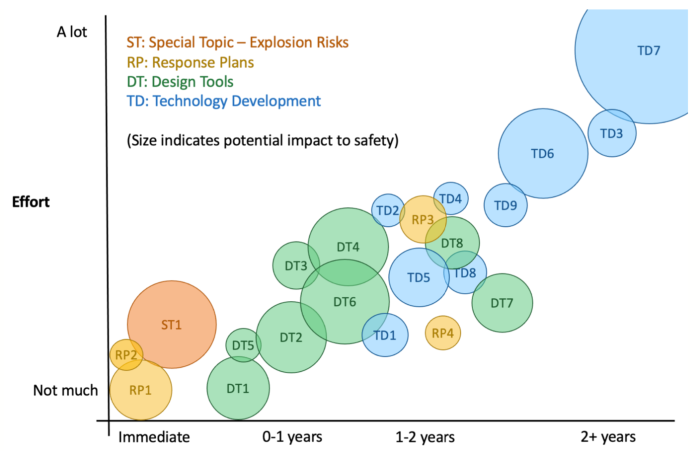
ST1 – Addressing the Common Explosion HazardRP1 – Response Plan Guidelines for Existing and Future BESSRP2 – Response Plan StandardizationRP3 – Hazard State Identification and CommunicationRP4 – Contamination ManagementDT1 – Improving Availability and Applica- tion of 9540A TestingDT2 – Inclusion of Gas Prediction and Deflagration Protection Tools in BESS Design ProcessesDT3 – Expansion of 9540A Testing to Address Statistical Variation and Multiple Cell FailuresDT4 – Guidelines for Selection and Design of Suppression SystemsDT5 – Standardized Electrical Controls ReportingDT6 – Failure Modes and Effects Analysis (FMEA) GuidanceDT7 – Integrated System Design ToolsDT8 – Adequacy and Inclusion of Thermal Runaway Propagation Prediction Tools in BESS Design ProcessesTD1 – Robust Electrical ControlsTD2 – Detection of State of Thermal ReactionTD3 – Detection of Future Thermal Runaway EventsTD4 – Detection of Deflagration and Toxicity RisksTD5 – Limitation of Propagation Using Thermal ControlsTD6 – Minimization of Thermal Runaway Using Thermal ControlsTD7 – Safe Cells with No Thermal Runaway PotentialTD8 – Thermal Runaway Vent Gas Routing Management During FailureTD9 – Ignition Control
Research topics are shown as circles represented with estimated potential improvement to safety of a single system (the size of the circle), estimated required effort to complete (Y-axis), and time frame of applicability (X-axis). Topic titles listed in the table below. To learn more about each Safety Roadmap task click on the bubbles above or links referenced in the table below to view the relevant section within the Battery Storage Fire Safety Roadmap document.
Safety Category Topic
ST: Special Topics ST1: Addressing the common explosion hazard
RP: Response Plans RP1: Response plan guidelines for existing and future BESS
RP2: Response plan standardization
RP3: Hazard state identification and communication
RP4: Contamination management
DT: Design Tools DT1: Improving availability and application of 9540A testing
DT2: Inclusion of gas prediction and deflagration protection tools in BESS design processes
DT3: Expansion of 9540A testing to address statistical variation and multiple cell failures
DT4: Guidelines for selection and design of suppression systems
DT5: Standardized electrical controls reporting
DT6: Failure modes and effects analysis (FMEA) guidance
DT7: Integrated system design tools
DT8: Adequacy and inclusion of thermal runaway propagation prediction tools in BESS design processes
TD: Technology Development TD1: Robust electrical controls
TD2: Detection of state of thermal reaction
TD3: Detection of future thermal runaway events
TD4: Detection of deflagration and toxicity risks
TD5: Limitation of propagation using thermal controls
TD6: Minimization of thermal runaway using thermal controls
TD7: Safe cells with no thermal runaway potential
TD8: Thermal runaway vent gas routing management during failure
TD9: Ignition control